Thermal duty
Capacity, inlet and outlet temperatures, flow rates and allowable pressure drop.
COMPACT HEAT TRANSFER
Compact, efficient heat transfer between two media for systems where installation space and thermal performance both matter.
Request product matching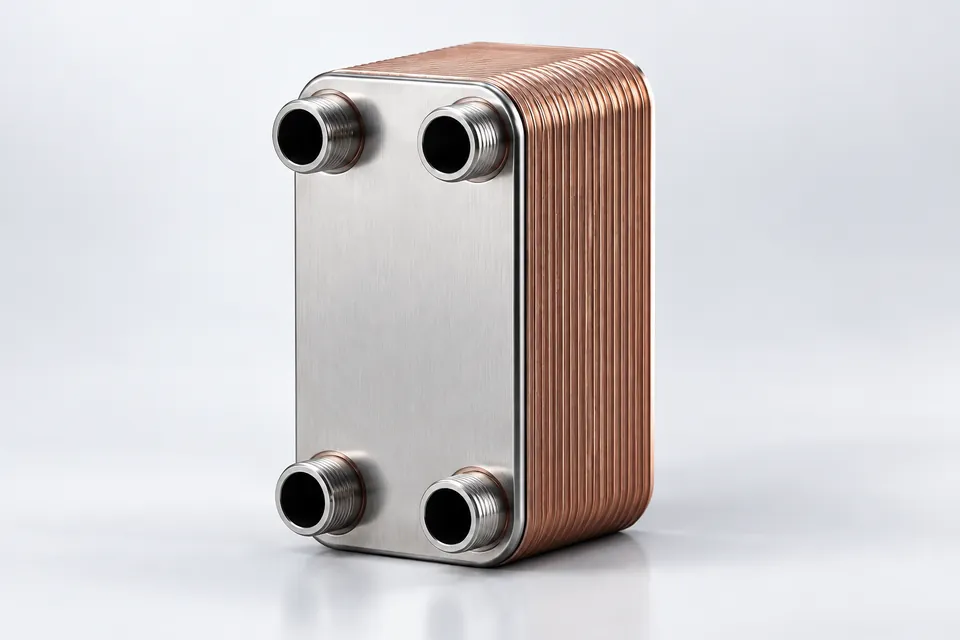
KEY FACTS
Capacity, inlet and outlet temperatures, flow rates and allowable pressure drop.
Water, glycol, oil, refrigerant or other process fluid, including concentration where relevant.
Plate material, brazing material, plate count and connection style are reviewed for the duty.
Design pressure, temperature range and applicable documentation must be confirmed before selection.
INDUSTRIES & APPLICATIONS
Brazed plate heat exchangers can serve as evaporators, condensers or single-phase exchangers depending on the selected construction and operating conditions.
Evaporating, condensing, liquid cooling and heat recovery duties.
Heating, cooling and energy transfer between building-service circuits.
Oil cooling, process cooling and temperature control in compact machinery.
Separation and transfer between primary and secondary liquid loops.
TYPICAL USE CASES
Selection begins with refrigerant, duty, saturation conditions, liquid temperatures and pressure-drop limits.
Approach temperature, seasonal operating range and freeze protection influence the final configuration.
Fluid properties, fouling tendency, available pumping pressure and connection layout must be considered.
PRODUCT OVERVIEW
A brazed plate heat exchanger transfers heat through a series of formed metal plates. Alternating flow channels keep the two media separate while creating a large heat-transfer area within a small footprint.
Corrugation and channel geometry affect turbulence, heat-transfer coefficient and pressure drop. The appropriate plate pattern, number of plates, materials and connection arrangement therefore depend on the actual duty rather than the external dimensions alone.
For product matching, send the available system data or an existing reference. Final dimensions, materials, ratings, performance and documentation are stated only in the corresponding quotation.
FAQ
Application, working fluids, inlet and outlet temperatures, flow rates, pressure limits, allowable pressure drop, connections and quantity are the most useful inputs.
Yes. A reference model, dimensional drawing, specification sheet or clear product photo can provide a practical starting point.
No. Website images are product concept illustrations. Construction, dimensions, materials and operating limits are confirmed for each quotation.
Include required drawings, inspection documents or commercial paperwork in your inquiry so the scope can be reviewed.
CONTACT
Send your heat duty, fluids, temperatures, flow rates, pressure limits, connections and quantity.